Internal.Tools.Deepen AI – The Smart AI Annotation Platform Transforming Machine Learning
- 1 What is Interna?.Tools.Deepen AI?
- 2 Main Features of Internal Tools Deepen AI
- 2.1 AI-Powered Annotation System
- 2.2 Advanced 2D and 3D Annotation
- 2.3 Multi-Sensor Support
- 2.4 Deepen AI supports:
- 2.5 Deepen AI for Autonomous Vehicles
- 2.6 Sensor Calibration Features
- 2.7 Deepen AI vs Traditional Annotation Platforms
- 3 Benefits of Using Internal.Tools.Deepen AI
- 3.0.1 Faster Workflow
- 3.0.2 Better Data Accuracy
- 3.0.3 Enterprise Collaboration
- 3.0.4 Scalable Infrastructure
- 3.0.5 Improved AI Performance
- 3.1 Advanced Validation and Quality Control
- 3.2 Industries Using Deepen AI
- 4 Final Thoughts
The rate of technological development is incredible. Artificial Intelligence has transformed the way organizations work entirely today. AI is increasingly making its way into all major industries, from self-driving cars to robotics and smart surveillance systems.
But there is one thing many folks don’t know.
AI systems need high-quality training data to perform well. This is precisely where Internal.Tools.AI’s depth becomes very significant.
Lately, I’ve seen numerous people searching for things like “internal.tools.deepen ai” and “internal tools deepen ai” on the web. Many AI developers, machine learning experts, and tech fans want to know what this platform actually does and why it is getting so popular in the AI business.
I have personally researched this platform quite deeply. After reading through several sources and analyzing their capabilities, I realized Deepen AI is becoming one of the most powerful AI data annotation and calibration platforms on the market.
In this article, I’ll tell you all about internal tools, deepen ai features, benefits, applications, and predicted future growth, and why firms are spending extensively on AI annotation systems.
What is Interna?.Tools.Deepen AI?
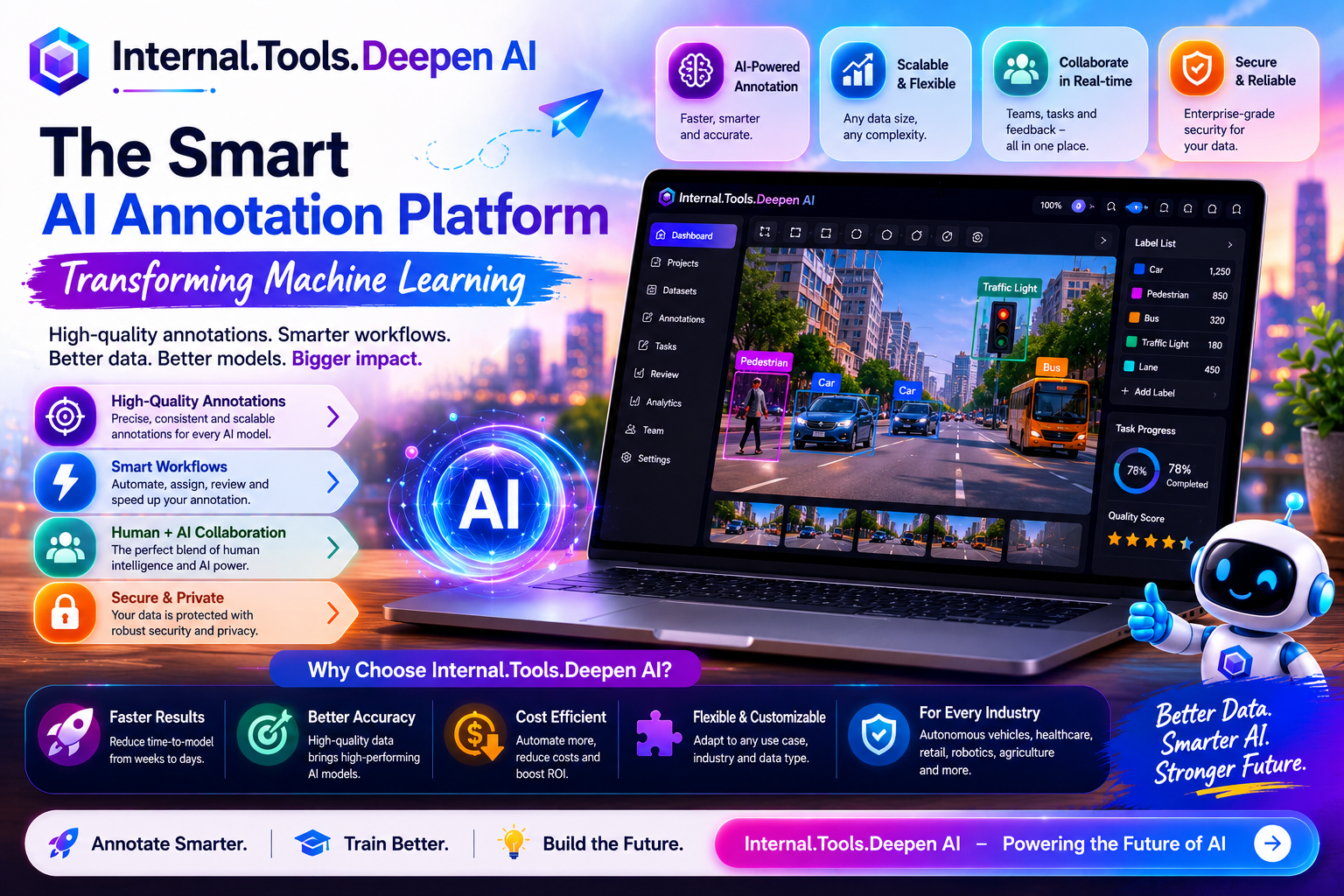
Internal.Tools.Deepen AI is a next-generation AI annotation and calibration platform for machine learning projects and autonomous systems. The technology primarily assists firms in processing massive volumes of training data for AI models.
The platform comprises:
- Image labeling
- Video tagging
- LiDAR Labeling
- Calibration of sensors
- AI-assisted tracking Data validation
- Managing machine learning workflow
The organization primarily operates in industries that prioritize precision above all else.
For instance:
- Autonomous
- Robotics
- Smart city surveillance
- Automation in the industry
- AI development
- Computer vision systems
According to the official website, Deepen AI delivers powerful tools to annotate, calibrate, and validate multi-sensor datasets utilized by AI systems.
Why is Deepen AI Becoming Popular?
Artificial intelligence is fast evolving worldwide.
Companies are building today:
- Self-driving cars
- Robots with AI
- Intelligent traffic systems
- Automated warehouses
- Smart surveillance systems
All these methods require very precise training data. Traditional annotation methods are sluggish and expensive. And sometimes they give contradictory results.
This is where Deepen AI comes in useful. The platform employs AI-assisted procedures that enable firms to accelerate labeling speed and data quality. I think that’s one of the key reasons why a lot of people are looking for Internal.Tools.Deepen AI on the internet.
Main Features of Internal Tools Deepen AI
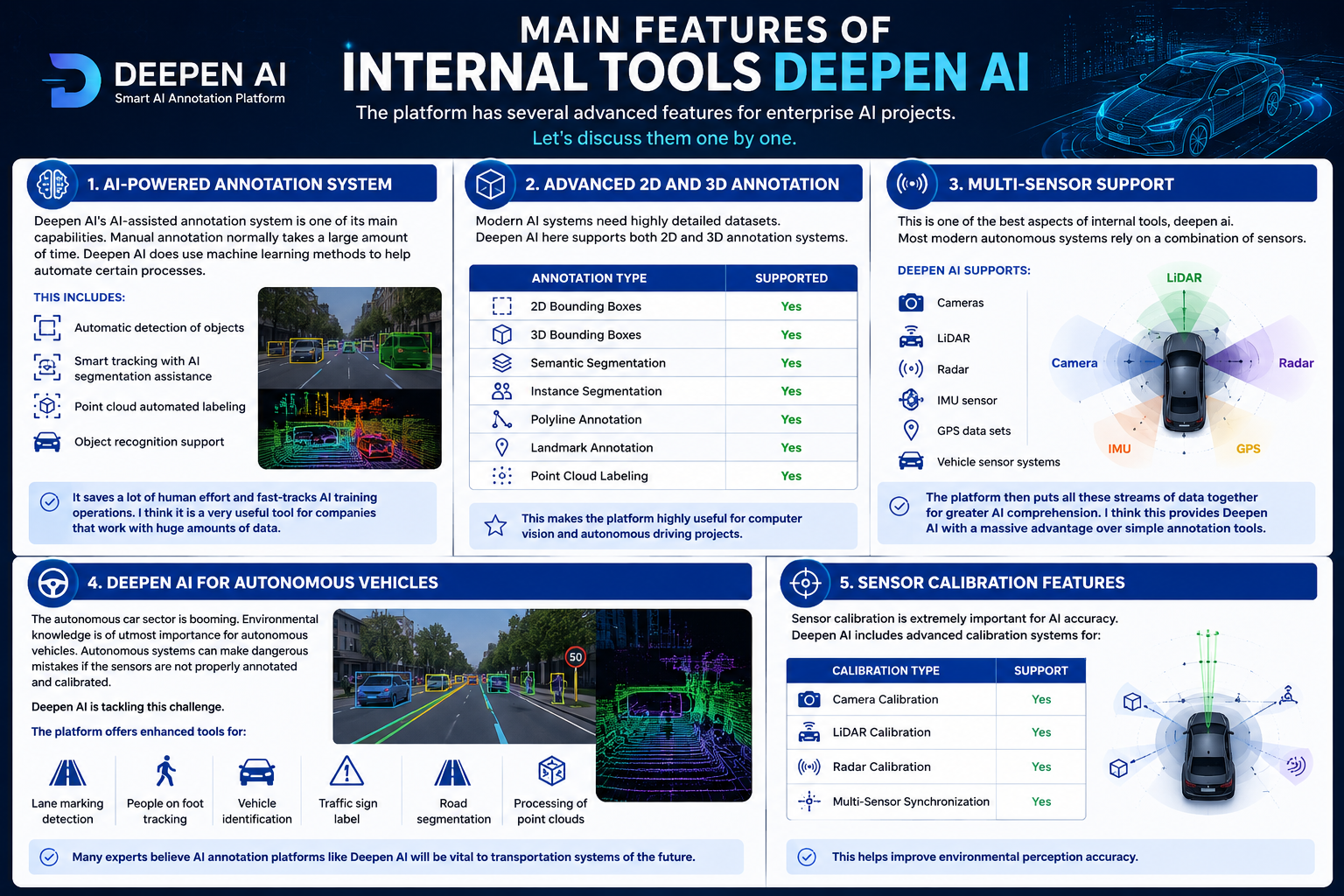
The platform has several advanced features for enterprise AI projects.
Let’s discuss them one by one.
-
AI-Powered Annotation System
Deepen AI’s AI-assisted annotation system is one of its main capabilities. Manual annotation normally takes a large amount of time. Deepen AI does use machine learning methods to help automate certain processes.
This includes:
- Automatic detection of objects
- Smart tracking with AI segmentation assistance
- Point cloud automated labeling
- Object recognition support
It saves a lot of human effort and fast-tracks AI training operations. I think it is a very useful tool for companies that work with huge amounts of data.
-
Advanced 2D and 3D Annotation
Modern AI systems need highly detailed datasets. Deepen AI here supports both 2D and 3D annotation systems.
The platform includes:
| Annotation Type | Supported |
| 2D Bounding Boxes | Yes |
| 3D Bounding Boxes | Yes |
| Semantic Segmentation | Yes |
| Instance Segmentation | Yes |
| Polyline Annotation | Yes |
| Landmark Annotation | Yes |
| Point Cloud Labeling | Yes |
This makes the platform highly useful for computer vision and autonomous driving projects.
-
Multi-Sensor Support
This is one of the best aspects of internal tools, deepen ai. Most modern autonomous systems rely on a combination of sensors.
Deepen AI supports:
- Cameras LiDAR
- Radar
- IMU sensor
- GPS data sets
- Vehicle sensor systems
The platform then puts all these streams of data together for greater AI comprehension. I think this provides Deepen AI with a massive advantage over simple annotation tools.
-
Deepen AI for Autonomous Vehicles
The autonomous car sector is booming. Environmental knowledge is of utmost importance for autonomous vehicles. Autonomous systems can make dangerous mistakes if the sensors are not properly annotated and calibrated.
Deepen AI is tackling this challenge.
The platform offers enhanced tools for:
- Lane marking detection
- People on foot tracking
- Vehicle identification
- Traffic sign label
- Road segmentation
- Processing of point clouds
Many experts believe AI annotation platforms like Deepen AI will be vital to transportation systems of the future.
Sensor Calibration Features
Sensor calibration is extremely important for AI accuracy. Deepen AI includes advanced calibration systems for:
| Calibration Type | Support |
| Camera Calibration | Yes |
| LiDAR Calibration | Yes |
| Radar Calibration | Yes |
| Multi-Sensor Synchronization | Yes |
This helps improve environmental perception accuracy.
Deepen AI vs Traditional Annotation Platforms
I personally compared Deepen AI with traditional annotation systems. The difference is quite significant.
| Feature | Traditional Annotation | Deepen AI |
| Manual Work | High | Reduced |
| Annotation Speed | Slow | Faster |
| AI Assistance | No | Yes |
| Multi-Sensor Support | Limited | Advanced |
| Enterprise Workflow | Basic | Advanced |
| Scalability | Medium | High |
This clearly shows why modern AI companies are moving toward AI-assisted platforms.
Benefits of Using Internal.Tools.Deepen AI
There are several advantages of using the platform.
Faster Workflow
A lot of manual effort is saved through automation with AI. This helps organizations finish tasks faster and boosts the overall efficiency of their work process. Speed is very crucial in today’s AI sector, and Deepen AI helps organizations do better with massive datasets.
Better Data Accuracy
Annotation consistency is improved via validation systems. This results in more powerful machine learning and smarter AI. This is one of the most significant things for me, as even a minor mistake in annotation can negatively impact the accuracy of AI.
Enterprise Collaboration
Workflow management solutions provide efficient team collaboration. Developers may review datasets, confirm annotations, and follow project progress all from one platform.
Scalable Infrastructure
The platform is ideal for startups and large companies. Deepen AI is scalable to large datasets and works with multi-sensor systems (LiDAR, radar, cameras, and GPS data).
Improved AI Performance
Better training data directly improves AI model performance. This is especially significant for safety-critical systems such as autonomous driving and robotics.
Also Read- Cyclemoneyco Cash Around: A Complete and Easy Guide for Smart Money Management
Advanced Validation and Quality Control
Poor data quality is a big problem in AI development. Deepen AI addresses this issue with improved validation mechanisms.
The platform features:
- Auto quality control
- Review workflows.
- Error handling
- Annotation verification
- Feedback loops
Personally, I think quality control is one of the best elements of the platform because AI systems are fully dependent on reliable datasets.
Industries Using Deepen AI
Deepen AI is utilized in different industries, such as:
- Self-driving
- Robotics.
- Smart Cities
- Industrial Automation
Final Thoughts
Internal.Tools.Deepen AI is one of the fastest-growing AI annotation systems in the IT industry. The future of machine learning and autonomous technologies will be largely driven by platforms like Deepen AI as artificial intelligence continues to evolve.
Hope you liked this complete guide on internal tools to deepen AI.
FAQs
-
Is Internal.Tools.Deepen AI is an AI annotation platform.
Sure, of course. It is meant primarily for AI annotation, calibration, and machine learning workflow management.
-
Does Deepen AI support LiDAR annotation?
Yes, the platform supports LiDAR datasets, point cloud annotation, and multi-sensor synchronization systems.
-
Is Deepen AI useful for autonomous vehicles?
Yeah, lots. The platform is generally beneficial for self-driving systems, including lane detection, sensor calibration, and object tracking.
-
Why is Internal? Tools. Deepen AI becoming popular?
The platform is gaining traction due to its AI-assisted workflows, enhanced automation, and enterprise-level annotation tools.
-
Can Deepen AI improve AI model accuracy?
Yes. Better annotation quality and validation mechanisms also help in improving the performance of the machine learning models significantly.